
The B.A.S.E. Method: Building Calm, Consistent Discipline at Home
Boundaries, Accountability, Structure, Effort. The four pillars that turn understanding into a system you can actually live by.
There is a particular kind of exhaustion that comes with parenting in the digital age. It is not only the physical tiredness of long days, though that is real enough. It is the mental weight of feeling like you are always negotiating, always reminding, always fighting the same battles over screens, homework, bedtimes and boundaries that seem to dissolve the moment you turn your back.
If any of that sounds familiar, you are not alone. Most of us have been there, myself included. Most of us have also felt that quiet worry underneath it all. If this is the pattern now, what happens as they grow older? What kind of adult are we actually raising?
The answer, in my experience, does not come from being stricter or from finding the one clever consequence that finally works, but from stepping back and building a real framework. It needs to be something calm, consistent and honest enough that our children can trust it, and simple enough that we can actually keep it going.
That is what B.A.S.E. is.
Four Pillars, Not Four Choices
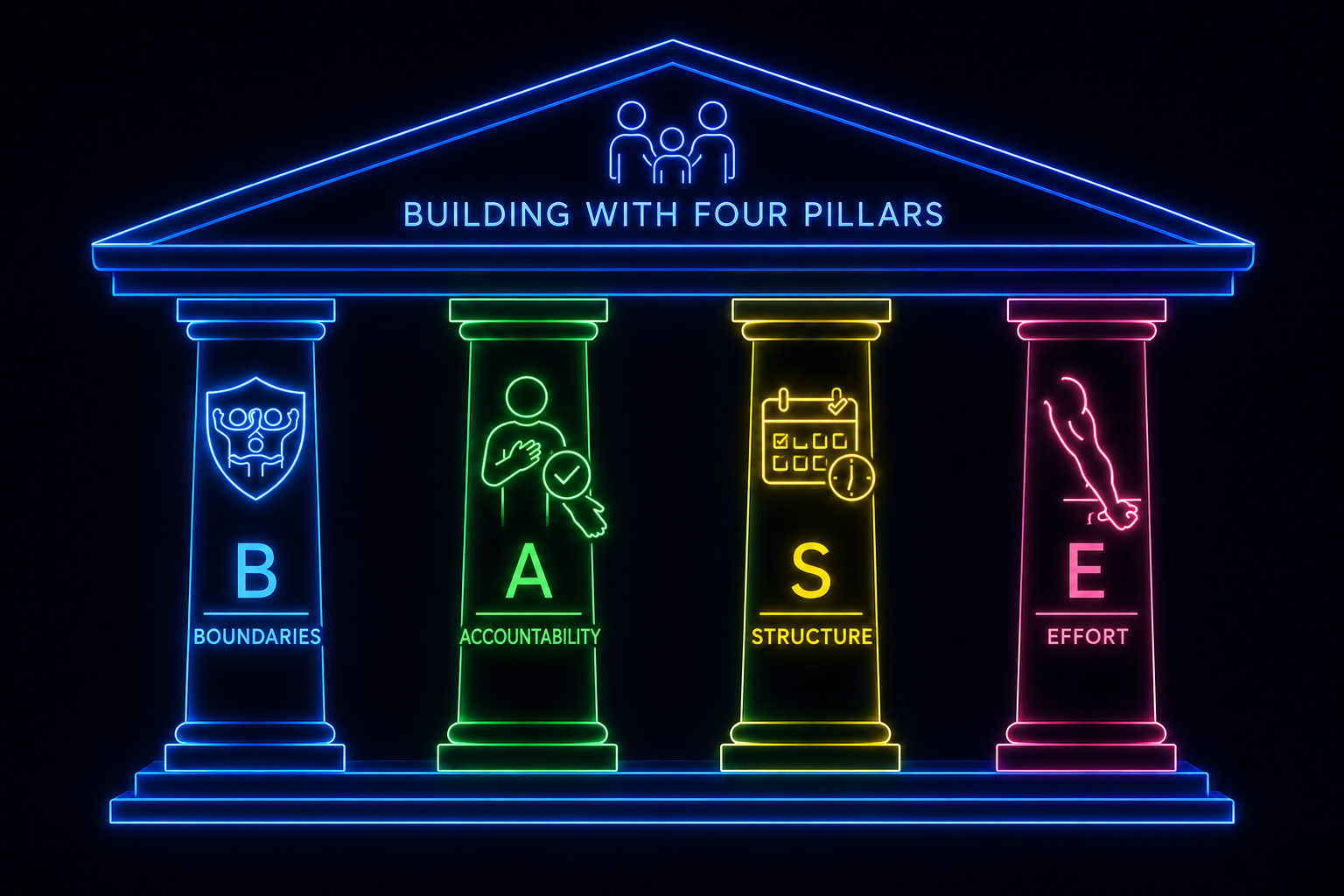
B.A.S.E. stands for Boundaries, Accountability, Structure and Effort. Each pillar plays a distinct role, and it is only when the four work together that a home starts to feel steady rather than reactive.
Boundaries set the clear lines. Accountability puts the weight behind those lines. Structure turns the new way of life into predictable routine. Effort gradually builds the internal motivation in your child that will one day carry them without you.
None of these works in isolation. Boundaries without Accountability are just suggestions. Accountability without Structure creates inconsistency. Structure without Effort becomes rigid rule-following. Effort without Boundaries and Structure leaves your child working hard in a vacuum. The four pillars lean on each other, and the framework only holds when all four are in place.
Boundaries: The Firm Edges
Children crave structure, even when they vocally resist it. Their prefrontal cortex, the part of the brain that handles impulse control and planning, does not fully develop until the mid-twenties. Until then, they need external boundaries to provide the self-control their brains cannot yet generate on their own.
In practice, this looks like a written Family Tech Agreement. It has specific time limits. It includes screen-free zones. Screen-free times are also detailed. Agreed consequences are listed. All of this is written down, signed and displayed somewhere visible. It needs to be backed up by parental control apps so that the rules quietly enforce themselves without you having to police every moment.
The mistake most of us make in the early days is compromising too soon. We write the agreement, then bend it the first time our child pushes back. Every compromise at the start weakens the whole framework. The early weeks call for firmness that may feel uncomfortable, because that firmness is the training ground your children need in order to take the boundaries seriously.
Accountability: Choices Have Weight
Accountability is the link between what our children choose and what happens next. In digital games, failure vanishes with the press of a button. In real life, choices carry weight. Children who grow up experiencing that connection develop the self-control and foresight that psychologists call executive function. Children who do not can grow into adults who feel that outcomes just happen to them, rather than result from their own choices.
Consequences work best when they are agreed in advance and logical. They should match the severity of the violation and be applied immediately. When the rule is broken, state the consequence once, calmly, and follow through. No lecture. No guilt trip. No trailing conversation about how disappointed we are. The lesson is that the choice had a natural outcome, not that Mum or Dad got angry.
Structure: The Rhythm That Runs on Its Own
Structure is the daily rhythm that runs quietly in the background of your home. A typical evening might follow snack after school, then homework, chores, outdoor play, dinner, wind-down and finally bed. Sameness counts here. When the sequence is predictable, children stop asking what is next. They just do it.
The first weeks of a new routine feel exhausting for everyone. This is because you are literally building new neural pathways through repetition. Stick with it for four to six weeks and something remarkable happens. The routine becomes automatic. Your child arrives home from school, has a snack, and moves to homework without conscious thought. The structure you built externally has become internal habit.
Effort: The Internal Side
The first three pillars are the framework we build around our children. Effort is the pillar we build inside them.
It is the work of coaching them through frustration instead of rescuing them from it. It means praising their effort rather than the result, and setting small, achievable goals so they experience regular success. It also means teaching them to name their emotions, breathe through them and try again. Every one of these moments builds the persistence and emotional regulation they will need for life beyond your home.
When Things Go Wrong
Somewhere in the first week, a moment like this will arrive. It is 7:15pm. Screen time ended at 7:00. Your child is still pleading for just five more minutes. You are exhausted. Every cell in your body wants to say yes just to end the conflict.
This is the moment that counts most. Your child’s tears are not evidence you are doing something wrong, but evidence something is changing. Their brain has become chemically dependent on the dopamine hits screens deliver, and what you are seeing is withdrawal, not harm.
Say once, gently but firmly: "I know this is hard. The rule stands. I am here when you are ready to do something else." Then walk away when you need to. Make yourself a cup of tea. Take three deep breaths. You are allowed to feel the exhaustion without changing the decision. Every time you maintain the boundary, you teach a lesson more powerful than a thousand lectures.
The Long Game
The exhaustion you feel now is temporary. The character and confidence you are helping your child develop will set them up for their future.
In our home, there came a moment I did not expect. My daughter asked me herself to reduce her weekend Roblox time because she felt it was distracting her from what she wanted to do. She had started recognising her own need for self-discipline, and she felt comfortable enough to ask for help. Those quiet wins remind me why we do the hard work.
B.A.S.E. does not require expert knowledge or expensive tools. It asks for commitment, consistency and courage. Some days will be messy. Others will surprise you. Both are part of the same journey, and the framework holds together even when we do so imperfectly.
These articles are drawn from the same parent-to-parent approach as the book, with more detail waiting there when you are ready.